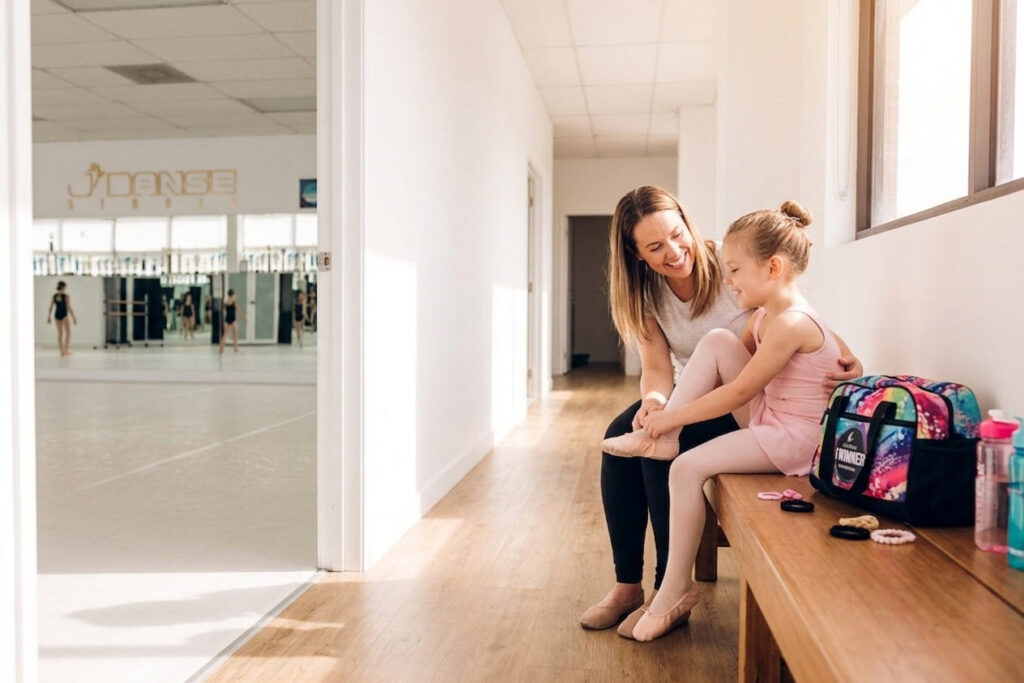
You have registered your child for their first dance class in Toronto. The date is coming up. And now the questions start. What actually happens in there? What will the instructor do? Will your child be nervous? Will you be able to watch?
The short answer: the first class at J’Danse Studio in Scarborough is structured, warm, and built specifically around first-timers. This post walks you through every part of what to expect at a dance class — from the moment you arrive to the moment you drive home.
If you are still in the preparation stage — sorting attire, hair, and arrival timing — read our First Dance Class Preparation Guide first. This post picks up where that one ends: at the studio door.
The First Five Minutes — Arrival and Welcome
You arrive at J’Danse Studio at 2105 Midland Ave, Unit 2, Scarborough. Free parking is directly outside. Walk in and you will be welcomed by a staff member who will point you toward the waiting area and confirm which room your child is in.
The instructor greets students at the door as they arrive. For younger children in Creative Dance or Mini classes, this moment matters more than most parents realise. A named, direct greeting from the teacher — “Hi, I’m Miss Sarah, I’m so glad you’re here” — sets the emotional tone for the entire class. J’Danse instructors are experienced with first-timers and handle this transition as a deliberate part of the class structure.
Your child enters the studio floor. You move to the parent viewing area. The class begins.
What Happens Inside — The J’Danse Class Structure
Every class at J’Danse Studio follows a consistent structure. Consistency is intentional — children settle faster and engage more deeply when the class format becomes familiar. Here is what that structure looks like:
Warm-up (first 5–10 minutes)
The class opens with a warm-up designed for the age group. For toddlers and Mini classes, this means music, movement games, and simple stretches delivered through play. For older recreational students, it involves more structured conditioning — footwork drills, across-the-floor exercises, and basic technique review. The warm-up eases children into the physical demands of the class and signals that the session has officially begun.
Centre work (middle section)
Students work in the centre of the floor on technique specific to the style. In ballet, this means positions, plié sequences, and basic port de bras. In jazz, it covers isolations, combinations, and rhythm work. In hip hop, it is groove foundations and musicality exercises. In acro, it is progressive skill work on mats with hands-on spotting from the instructor. This section is where most of the technical teaching happens.
Choreography or combination work
Toward the end of class, students put technique into movement — either a short choreographed sequence or a combination across the floor. This is typically the most exciting part for children. They see themselves doing real dance, not just exercises.
Cool-down and close
The class ends with a brief cool-down stretch and a consistent closing ritual — something as simple as a circle, a clap, or a goodbye moment. For young children, this ritual creates a sense of completion and gives them something to look forward to returning to next week.
What the Instructor Does Differently in a First Class
Experienced instructors adjust their approach for first-timers. At J’Danse Studio, the first class follows several specific practices that make the transition easier for new students.
Individual acknowledgement. The instructor notices each child by name and makes brief personal contact before or during warm-up. For a child who is feeling nervous, being seen by name by the teacher is one of the fastest ways to reduce anxiety.
Demonstration first, instruction second. In a first class, instructors show before they tell. Children who have never heard the word “plié” understand it immediately when they see it demonstrated. Verbal correction comes later, once the child has had a chance to try the movement themselves.
No pressure to perform. The first class is an observation and exploration. Instructors at J’Danse do not expect new students to execute technique correctly from day one. They expect children to try, enjoy the process, and want to come back. Those are the only three measures that matter in class one.
According to AboutKidsHealth at SickKids Hospital, children adjust to new structured environments significantly faster when they receive individual attention from a trusted adult in the first session. Instructor-led acknowledgement is not just good teaching practice — it is developmentally necessary for the age groups J’Danse works with.
What You Will See From the Viewing Area
Parents wait outside the studio floor during class. This is a deliberate policy — children focus better and build independence faster when the class belongs to them, not to their parents’ gaze.
From the viewing area, you will typically see the following through the window or monitor:
Some children engage immediately and fully. Others watch for the first five to ten minutes before joining. Both are completely normal. The instructor continues without drawing attention to the hesitation — bringing quieter children in gradually through proximity and inclusion rather than direct instruction to participate.
If your child cries during a first class, the instructor will handle it. They are trained in early childhood transitions. They will not ignore it, and they will not escalate it. Most children who cry in the first five minutes of a first class are participating enthusiastically by the ten-minute mark.
What to Ask Your Child Afterward
The instinct is to ask “Did you like it?” or “What did you learn?” Both are reasonable questions. But the most useful question after a first class is simpler:
“What was your favourite part?”
This question assumes a positive experience and invites a specific memory rather than a yes/no evaluation. Children who answer this question — even with something small — are telling you the class gave them something worth remembering. That is the only result that matters after class one.
The Difference Between the First Class and the Tenth
The first class at J’Danse Studio is an orientation. Your child is processing a new environment, new peers, a new instructor, and new physical expectations simultaneously. What you see in week one is not a reliable measure of what your child will be like in week ten.
Children who look uncertain and half-participating in the first class are often among the most confident and engaged students by the end of the first month. The transition period is real and normal. Trust the structure — it is designed for exactly this.
Ready to Book?
J’Danse Studio offers a free trial class for all new students. No registration fee. No commitment. One class to experience the studio, meet the instructor, and see what to expect at a dance class in Toronto firsthand.
Book a free trial class →
Read our First Class Preparation Guide →
View the full Dress Code →