
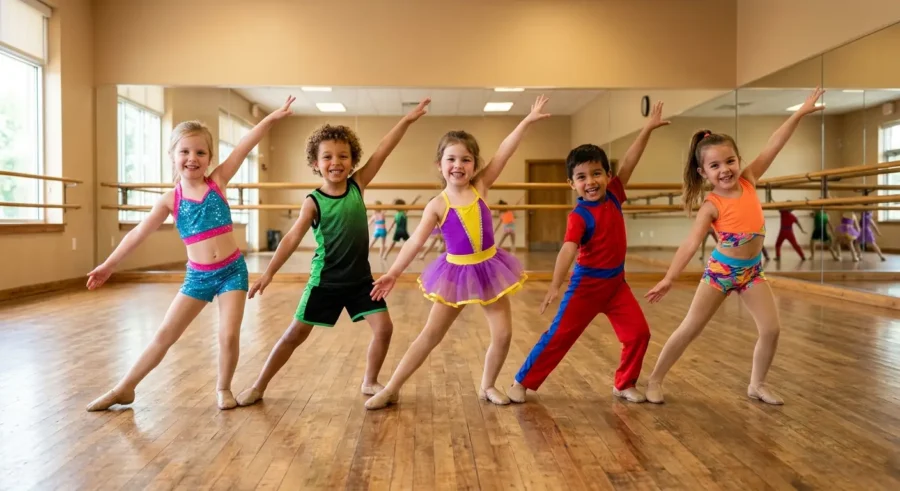
The short answer: dance builds coordination, strength and musicality, but the benefits parents actually notice first are usually behavioural — better focus, more confidence in front of people, and a greater willingness to be bad at something before getting good at it. At J’Danse Studio in Scarborough we have watched sixteen seasons of dancers grow up, and those are the changes families mention most.
The Physical Benefits Are Real, and They Are Not the Main Point
Dance develops strength, flexibility, balance, posture and spatial awareness, and it does so in a way that few childhood activities match. A dancer learns to control their body deliberately rather than incidentally.
Two things make it unusual among physical activities. First, it trains both sides of the body relatively evenly, where many sports develop a dominant side. Second, it combines cardiovascular work, strength work and flexibility in a single session, which is uncommon.
Posture is the benefit parents see earliest. Children who dance tend to stand differently within a few months, and it is noticeable enough that relatives comment on it.
But in our experience, physical development is rarely why families stay enrolled for years. The reasons they stay are less obvious.
Focus, Built in Small Increments
A dance class is a sustained exercise in attention. A child watches a sequence, holds it in memory, reproduces it with their body, and adjusts it based on correction — repeatedly, for forty-five minutes or an hour.
That loop is cognitively demanding. Remembering an eight-count combination is working memory. Executing it while staying in time is divided attention. Taking a correction and applying it on the next attempt is self-monitoring.
Children get measurably better at this, and it is one of the clearest changes we see across a season. A dancer who could hold four counts in September is holding a full routine by spring. Parents frequently report that the ability to follow multi-step instructions shows up at home and at school too.
Confidence That Comes From Being Watched
Dance involves performing. Not only at the recital — a child is watched in every class, corrected in front of peers, and asked to dance across the floor while others wait their turn.
That is uncomfortable at first for most children, and it is precisely why it works. Being observed while attempting something imperfectly is a specific fear, and the only way through it is repetition in a setting where getting it wrong is normal and expected.
The confidence that results tends to be durable because it is earned rather than granted. A child who has stood on a stage in front of several hundred people has evidence about themselves that no amount of encouragement can substitute for.
This is the benefit we hear about most often from families years later — not that their child became a dancer, but that their child became someone who could speak up in class.
Learning to Be Bad at Something First
This may be the most valuable thing dance teaches, and it is the least discussed.
Every new skill in dance begins badly. The first attempt at a pirouette is wobbly. The first tap combination is muddy. The first time a dancer tries a back walkover with less support, it is untidy. Progress happens visibly through a stage of being obviously not good yet.
Children who train in dance learn that this stage is normal and survivable rather than evidence of failure. In a culture where many children quietly avoid things they cannot immediately do well, that is a significant lesson, and it transfers well beyond the studio.
Musicality and Rhythm
Dancers learn to hear structure in music — counting, phrasing, where a passage resolves. That understanding transfers directly to learning an instrument, and children who dance before taking up music frequently find counting and timing noticeably easier.
Styles differ in how directly they build this. Tap is the most explicit, since the dancer creates the rhythm. Lyrical and contemporary teach phrasing and musical interpretation. Hip hop develops a sharp sense of beat and syncopation.
Social Benefits, Including the Unglamorous Ones
A dance class is a group working toward a shared performance, which produces a particular kind of cooperation. Dancers rely on one another for spacing, timing and formations — one person out of position affects everyone.
Small classes matter here. At roughly six to ten dancers, children know each other by name and are known by the instructor. In a class of twenty-five a quieter child can pass through a whole season largely unnoticed.
Dance also mixes ages and abilities more than school does. Older dancers help younger ones, and children regularly see someone slightly ahead of them doing what they are working toward, which is a more motivating model than an adult demonstration.
What Dance Does Not Do
In the interests of being straight about it: dance will not make an unfocused child focused in a month, it will not resolve deep shyness on its own, and it is not a replacement for physiotherapy or occupational therapy when those are needed.
The benefits above are cumulative and they take seasons rather than weeks. Families who see the largest changes are the ones who stayed for several years — which is also why instructor consistency matters. Our team has stayed together across our sixteen seasons, so dancers are taught by people who have known them for years.
Frequently Asked Questions
What age should a child start dance to get these benefits?
Children can start creative movement from 18 months, and style-specific classes from around four. There is no age at which it is too late — a child starting at ten gains the same benefits, often faster, because they bring more developed focus to begin with.
Is dance good for children who are not naturally coordinated?
Yes, and arguably more so. Coordination is trained, not innate. Children who start with less of it tend to show the most visible improvement, because the gap between where they begin and where they arrive is larger.
Does my child need to be competitive to benefit?
No. Recreational dancers get the full range of benefits described here. Competitive training adds intensity and performance volume, but confidence, focus and coordination come from consistent weekly classes, not from competing.
Is dance beneficial for boys?
Yes, identically. The strength, coordination and rhythmic training apply regardless, and hip hop, tap and acro are frequently the styles boys engage with first. We have had boys train with us across multiple styles and years.
How long before we see a difference?
Posture and coordination typically within a term. Focus and confidence over a full season or more. Families who stay several years describe the change as substantial, but it is gradual rather than sudden.
Getting Started in Scarborough
J’Danse Studio has taught at 2105 Midland Avenue, Unit 2 in Scarborough since 2010, serving Agincourt, Malvern, Wexford, Maryvale, Bendale and the east GTA. We offer Creative Dance from 18 months, plus Ballet, Jazz, Hip Hop, Acro, Tap, Lyrical, Musical Theatre and our competitive program, Team JDS.
If you are unsure which style suits your child, our guide on choosing the right dance style is a good starting point, or contact the studio and we will point you to the right class. You can also browse the full schedule. New students currently receive $50 off registration.


