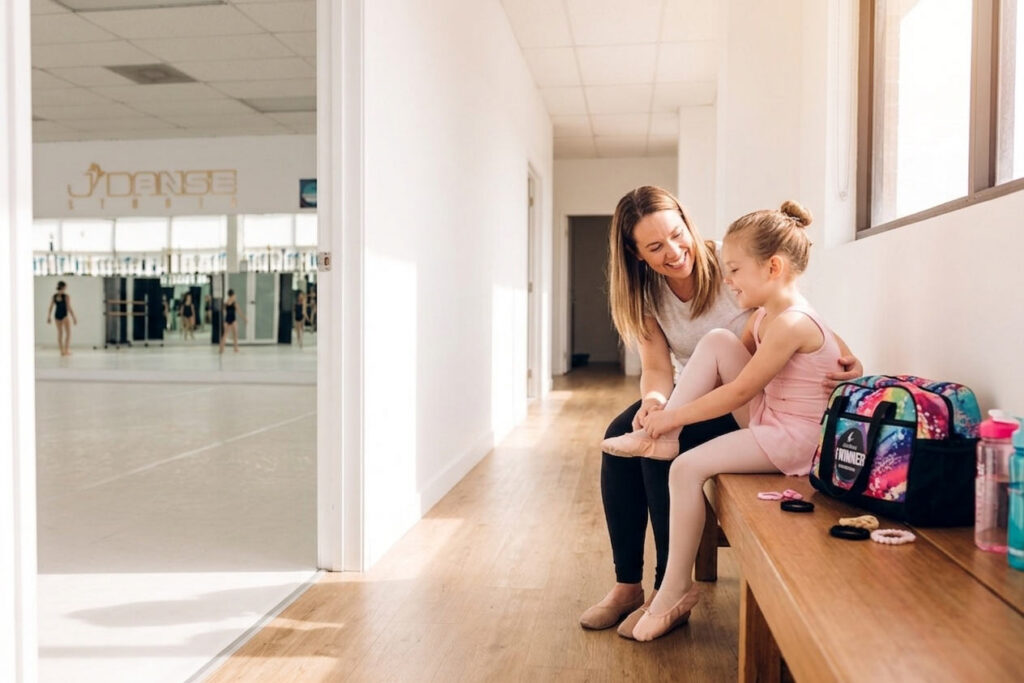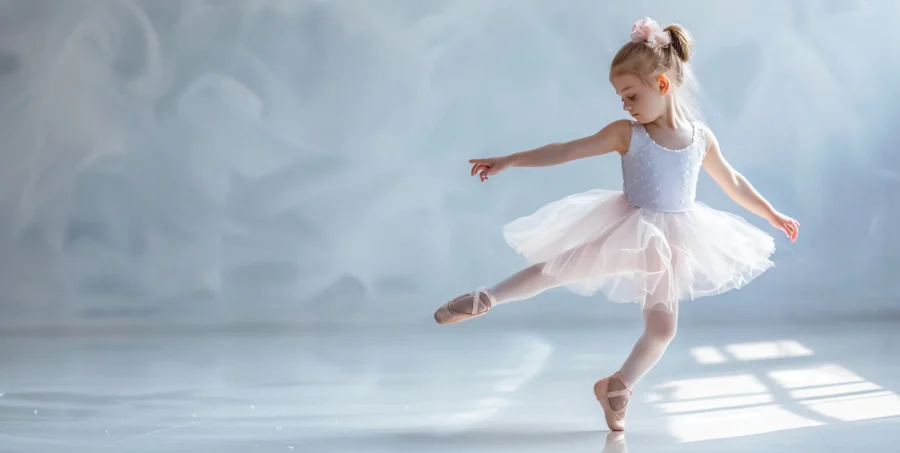
The short answer: yes, two and three year olds can absolutely start dance — but what a class looks like at that age is very different from what most parents picture. At this stage a good class is about movement, music, imitation and routine, not technique. At J’Danse Studio in Scarborough, children can start Creative Dance from 18 months, which is the earliest start of any studio we are aware of in the area.
What a Class Actually Looks Like at Two and Three
Parents often arrive expecting a miniature ballet class — small children at a barre, in lines, learning positions. That is not what works at this age, and a studio that tries it will spend the hour managing frustration.
A class for two and three year olds is built around short, repeated activities. Children move to music, copy the instructor, use props like scarves and hoops, travel across the floor in different ways, and learn the shape of a class: we start here, we do this, we finish here. Each activity lasts a few minutes because that is roughly the attention span available.
Underneath the play, the class is doing real work. Children are learning to follow instruction from an adult who is not a parent, to wait for a turn, to move in time with music, and to control their bodies in space. Those are the foundations every later dance style is built on, and they are genuinely hard skills at this age.
Is My Child Too Young?
The useful question is not age but readiness, and readiness at this stage has very little to do with coordination.
Can your child manage without you for 45 minutes? This is the real variable. Some two year olds separate happily. Some three year olds do not. Neither is a problem, and neither predicts whether a child will enjoy dance — it only affects how the first few weeks go.
Can they follow a simple instruction? “Everyone to the circle” or “hands on your head.” Not perfectly, and not every time. Occasionally is enough.
Do they respond to music? Most do. A child who moves when music plays has everything they need to start.
Toilet training is generally not a barrier at this age, and a good studio will tell you so rather than making it a condition.
The First Few Weeks Are Not the Verdict
This is the single most useful thing to know before enrolling a two year old.
It is entirely normal for a child this age to spend the first class standing still and watching. Or to join in enthusiastically for ten minutes and then sit down. Or to do well for two weeks and then have a difficult third week for no visible reason.
None of that means your child dislikes dance or is not ready. Children at this age frequently learn by observing before they participate, and a child who watches from the edge is usually absorbing a great deal. Instructors who work with this age group expect it and are not concerned by it.
Give it four to six weeks before drawing any conclusion. The children who look least engaged in week one are often indistinguishable from the rest by week six.
Should a Two Year Old Do Ballet Specifically?
Generally, no — and this is worth understanding because “ballet for toddlers” is a very common search.
Formal ballet asks for turnout, precise foot positions and sustained postural control. A two year old’s hips, ankles and attention are not developmentally ready for that, and pushing it early produces poor habits rather than early advantage.
What works instead is creative movement, which includes balletic elements — pointing toes, light steps, graceful arms, moving to classical music — without the technical demands. Children who start this way and move into formal ballet around four or five are not behind. If anything they arrive with better musicality and a genuine enjoyment of moving, which matters more at that point than a head start on positions.
How Long Should a Class Be?
Forty-five minutes is about right for this age. Shorter and the class ends just as the children settle; much longer and attention is gone well before the end.
Once a week is plenty. Parents sometimes ask whether twice weekly would accelerate progress at this age. It generally does not — what drives progress at two and three is consistency and familiarity, not volume.
What to Bring, and What to Wear
Comfortable fitted clothing the child can move in, hair tied back if it is long enough, and ballet shoes or bare feet depending on the class. Nothing elaborate is needed at this stage.
Bring a labelled water bottle. Skip the elaborate costume — children this age are frequently distracted by their own outfit, and a tutu that needs adjusting mid-class is a genuine obstacle. Our dress code guide sets out what is needed by class.
Starting From 18 Months in Scarborough
J’Danse Studio has operated from 2105 Midland Avenue, Unit 2 in Scarborough since 2010 — sixteen seasons at the same address — serving families across Agincourt, Malvern, Wexford, Maryvale, Bendale and the wider east GTA.
Our Creative Dance program takes children from 18 months to four years. Among Scarborough studios, minimum ages commonly sit at two or four; starting at 1.5 gives families a genuine option earlier than most, and means a child can move through creative movement and into style-specific classes at their own pace rather than waiting for an arbitrary cut-off.
Classes stay small, at roughly six to ten children. At this age that is not a luxury — an instructor managing twenty toddlers is managing behaviour, not teaching dance.
Frequently Asked Questions
Can a two year old really do a dance class?
Yes, provided the class is designed for that age. A class built around movement, music, props and repetition works well at two. A class built around technique and formal positions does not.
Do parents stay in the room?
Our classes run without parents in the studio, which helps children settle into following the instructor. Families can watch through our studio-viewing setup, and instructors are experienced with children who need a gradual start in the first weeks.
What if my child cries or will not join in?
It is common and it is temporary. Instructors who teach this age expect it. Most children who struggle in week one are participating normally within a month, and watching from the side is a legitimate way to learn at this age.
Is dance better than a general toddler activity class?
They do different things. A general play class is broader; dance is more structured and more musical, and it builds the specific habit of following a sequence to music. If your child responds strongly to music, dance tends to hold their attention longer.
What is the difference between Creative Dance and a ballet class?
Creative Dance develops movement vocabulary, musicality, coordination and class routine through play. Ballet teaches a specific technique with defined positions and terminology. Creative Dance is the right starting point before four or five; ballet follows naturally from it.
Starting Out
If you are considering dance for a two or three year old, the best first step is to talk through your child’s age and temperament with us so they start in the right class rather than the nearest-fitting one. You can contact the studio directly, see the Creative Dance program, or browse the full schedule. New students currently receive $50 off registration.